
Growth changes the questions a roastery has to answer. In the beginning, production may revolve around one roaster, a manageable number of coffees and a small team that communicates constantly. The person developing the profiles may also be the person roasting the production batches, cupping the coffee and working directly with customers. Knowledge moves easily because everyone is close to the work.
Then the business grows. Wholesale accounts or retail locations increase, production days get longer, another operator joins the team and demand begins pushing the existing roasting setup closer to its limits. What once depended on experience and informal communication now has to become a system. The challenge is no longer simply making more coffee. It is finding a way to make more coffee without losing the knowledge, intention and quality that created the growth in the first place.
This is a challenge we think about often at Loring, because scaling a roasting business involves much more than selecting a machine with a larger batch capacity. It requires looking at how profiles transfer, how operators work, where production slows down, how much attention the equipment requires and whether the roasting system can continue supporting the company’s standards as complexity increases.
A growing roastery can expose variability that was always present but easier to manage at a smaller scale. A head roaster may instinctively recognize that a particular coffee needs a slight adjustment or understand how conditions in the roastery are affecting a batch. As more people enter production, those decisions cannot remain entirely dependent on one person’s memory or intuition. Some of that knowledge has to become visible, teachable and repeatable.
Roast profiles are part of that process, but they are only one piece. Warm-up procedures, green-coffee handling, quality-control practices, production sequencing and clear expectations around what happens when a roast falls outside its normal range all become increasingly important. The objective is not to eliminate individual expertise. It is to build a system capable of carrying that expertise farther.
That principle has influenced the way Loring Smart Roasters are designed. The Loring line uses the same core single-burner convection approach across multiple machine sizes, from the S7 Nighthawk through the S70 Peregrine. That gives growing roasting teams the ability to develop around a familiar roasting environment instead of treating every increase in production capacity as an entirely new way of working.
It also changes the conversation around profiles. A profile developed on one Loring can provide a foundation that can be carried into different Loring machines and batch sizes, giving the roaster a more consistent starting point as production needs change. The goal is not simply to make the larger machine behave like the smaller one. It is to make it easier for the knowledge developed through roasting and cupping to travel with the company as it grows.
That matters because increasing capacity should not require starting over creatively. If a team has spent months understanding how a coffee responds, dialing in its roast and determining how they want it to present in the cup, growth should allow them to build on that knowledge rather than abandon it.
Capacity, however, is only one part of scaling. A roastery can install a larger commercial coffee roaster and still find that production has not become meaningfully easier. The true bottleneck may be weighing and moving green coffee, cooling, destoning, packaging, staffing or the amount of manual attention required during each batch. Growth puts pressure on the entire workflow, which is why equipment decisions need to consider the production system around the roaster rather than the roaster in isolation.
This is another area where Loring’s approach becomes relevant. Automation is built into the roasting process to handle tasks such as loading green coffee, charging the roast chamber, following an established profile, discharging roasted coffee and cooling the finished batch. As volume increases, reducing those repetitive production steps can allow an operator to spend less time physically managing the machine and more time overseeing quality, preparing the next batch or supporting other parts of the operation.
The same is true of efficiency. The economics of a roasting decision can look very different when a company moves from roasting several batches a week to running equipment for hours every day. Energy use, labor, floor space and production time all become more consequential as volume increases. Loring’s single-burner convection system is designed to use the same burner for roasting and smoke incineration rather than requiring a separate external afterburner, while recirculating heat within the roasting system. Those engineering decisions become increasingly meaningful when evaluated across a larger production schedule.
A well-designed roasting operation also needs room to flex. Growth rarely happens in a perfectly straight line, and production demand is rarely identical from one coffee to another. A roasting team may need larger batches for its highest-volume coffees while still wanting smaller runs for seasonal releases, reserve coffees or custom orders. Loring roasters are designed to operate across a range of batch sizes, giving production teams more flexibility to adapt the machine to the coffee and the order rather than forcing every roast into the same production model.
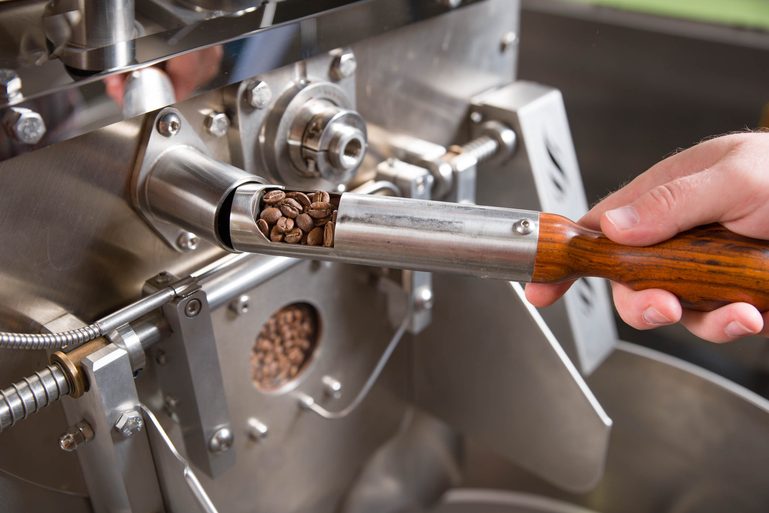
None of these systems removes the need for experienced people. In fact, growth often makes that experience more valuable. What changes is how the knowledge is shared. A company that depends entirely on one person’s instincts becomes vulnerable as production expands. A company that combines experienced people with repeatable profiles, shared data, thoughtful training and equipment designed around consistent control has a much stronger foundation.
The result should not be a production environment where operators simply follow instructions. The goal is a place where knowledge can travel. A new operator should be able to understand not only what a profile does, but why it was developed that way. A head roaster should be able to compare results across batches and teach from real information. A growing team should be able to preserve its standards while continuing to question, cup and improve.
That is ultimately what scaling well looks like. More coffee leaves the roastery, but the thinking behind it does not get diluted along the way.
At Loring, we believe roasting equipment should help make that possible. From the S7 Nighthawk to the S70 Peregrine, the objective is not simply to offer increasingly larger machines. It is to provide a roasting platform that can grow alongside the people using it, helping roasters carry their profiles, their knowledge and their standards into whatever comes next.
Growth should change the scale of your operation. It should not require you to leave behind what made the coffee worth growing in the first place.