
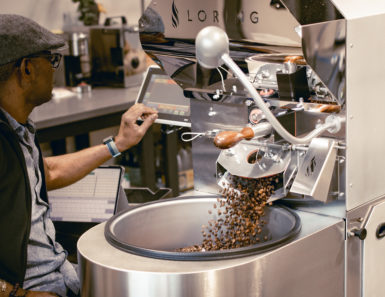
If you’ve spent time in the roasting world, you’ve probably heard a lot more conversation lately about convection roasting. And for good reason — convection coffee roasting machines offer cleaner flavor, better consistency, and significantly greater efficiency compared to traditional drum roasters.
Loring’s single-burner convection design takes these advantages even further, helping roasteries produce exceptional coffee while dramatically reducing fuel use and emissions.
Let’s break down why convection roasting has become the preferred method for modern specialty roasteries.
What Is a Convection Coffee Roasting Machine?
Q: How does convection roasting work?
A: In a convection roaster, beans are roasted by circulating hot air, not by touching a heated drum. This creates an even, controlled environment that roasts every bean consistently.
Loring’s system takes convection a step further by using one burner to heat the roasting chamber and eliminate smoke—meaning cleaner heat, cleaner air, and cleaner flavor.
Convection vs. Drum Roasting: What’s the Difference?
Q: Why does convection produce a cleaner flavor?
A: Because hot air surrounds each bean evenly, there’s no risk of:
- Scorching
- Tipping
- Hot spots
- Drum-contact defects
This is especially valuable for showcasing:
- High-end microlots
- Washed and natural processing notes
- Subtle acidity and florals
- Light and modern roast styles
Why Do Convection Roasters Create More Consistent Roasts?
Q: How does airflow impact consistency?
A: Airflow is the engine behind roasting. Convection machines control airflow precisely, which ensures:
- Stable heat transfer
- Repeatable profile curves
- Even bean development across the batch
- Reliable results across different roasting staff
Loring’s Smart Roast controls automate this precision, helping replicability from batch to batch and location to location.
Why Are Convection Roasters More Efficient?
Q: Do convection roasters really save that much fuel?
A: Yes. Loring’s patented single-burner system uses up to 80% less fuel than many drum roasters.
Here’s why:
- No need to heat a heavy metal drum
- No separate afterburner consuming additional fuel
- Closed-loop air system recycles heat efficiently
Fewer BTUs burned = lower emissions + lower costs.
👉 See Loring’s sustainability impact.
Are Convection Coffee Roasters Better for Sustainability?
Q: How does convection help roasteries lower their footprint?
A: Convection systems, especially Loring’s, reduce:
- Carbon emissions
- Energy usage
- Particulate output
- Environmental compliance costs
Many roasteries choose Loring not just for efficiency, but because sustainability is core to their brand and customer expectations.
Who Should Consider a Convection Roasting Machine?
A convection roaster is ideal for:
- Growing roasteries focused on consistent quality
- Businesses committed to reducing emissions
- High-volume producers needing efficiency
- Roasteries with limited space (no afterburner required)
- Teams looking to replicate roast profiles with precision
Whether you’re roasting 7 kg at a time or 70 kg, convection provides quality and stability that traditional drum roasters can’t match.
Conclusion
Convection coffee roasting machines have reshaped what’s possible in specialty coffee. With cleaner heat, more consistent roasting conditions, and dramatically better efficiency, they offer roasteries a clearer, more sustainable path to quality.
Loring’s single-burner convection system leads the way — delivering unparalleled flavor clarity, lower operating costs, and a smaller environmental footprint.
👉 Explore the full lineup of Loring convection roasters to find the right fit for your roastery.